I've been busy the last few days so this post is a bit late in terms of writing. However it has been going around my head for a couple of days.
Now, the dust is beginning to settle on the Henry handball situation. One of the debates I have had with several of my friends is if this is what Henry will now be remembered for.
I refer back to the old story of service. If you get great service in a restaurant every time for a 100 visits, you may tell the odd person. However, if you get terrible service just the once, you tell ten people, who then tell ten people etc etc. Basically, one bad deed can ruin a brands reputation for good, people may never trust/use that brands product or service again. It also creates a knock on effect as people tell their peers.
Now, does this work in terms of brand Henry? Of course it does. Sure, he scored some screamers; he won the Premier league title and the world cup. He was once arguably the best player in the Premiership. However, the handball is without a doubt the most negative aspect of his career. Unfortunately for Henry it is extremely likely this is what people will talk about when they mention his name in years to come. Don't believe me? What is the first thing you think of when I say Maradona? Thought so.
Like many around the world I tuned in to see David Haye take on the giant, Nikolai Valuev. Haye was speedy, stuck to his tactics and placed his shots. Valuev did little or nothing, slow to react, threw the odd punch and ultimately hoped his sheer size would win the fight for him.
Now, I will be honest, I was surprised Haye won. He didn't really land many punches apart from one big one in the final round but he did something Valuev didn't do. He showed heart, confidence and dared to stand toe to toe with the big man.
It made me think about the market place that many brands operate in. They won't compete head on with the big market leader, the sheer dominance and size of the leader brand scares them, after all one blow could, in a sense could knock them out. So, instead they follow the leader brands footsteps and do little or nothing to take its customers.
What they should do instead is exploit the leader brands weaknesses. Be nimble and take risks. Larger corporations are slower to react to trends, less likely to take risks and in many markets will coast along as they don't think anyone call challenge their dominance. A great example is Virgin.Virgin Atlantic had less than a fifth of BA's marketing budget but, thanks to its aggressive and provocative advertising - as well as Sir Richard Branson's fondness for PR stunts - the challenger airline now has a high profile.
So, take one out of David Haye's book. Take on the big guys, they aren't as scary as they look. Even how hairy they are!
Redscout’s SPUR video series is something of great interest to me and many others, I'm sure. Being a young planner "wannabe" it's interesting to see how experienced practitioners view the world of planning and how they think it will shape up in the future. I'm looking forward to future editions of the video series.
Here's a something I found particularly interesting:
"Planning was conceived as the thinking behind creativity. But the conventional planner has become a caricature: thinking in an ivory tower and post-rationalizing the doing of others. But today – as the industry, agency, and world-at-large have evolved – the definition of planning, and its future, is unclear."
Building on this thought, I recently asked some planners on twitter for their views on "what makes a good planner?” all in 140 characters. All the responses that I recieve will be added to this blog post, as and when I recieve them.....
All other responses are also welcome :)
.
Armano "Curiosity, excellent communication skills, an analytical mind, creative spirit and the ability to detect and synthesize patterns"
markhadfield "A good Planner is being able to provide more than 1 answer to this question, but throwing out the wrong ones and keeping the best." "(and to always have the last word. ;-) )"
jasonlonsdale "A great planner should be the trusted provocateur: strategically robust yet creatively inspiring; laser-focused yet open-minded"
Will_Humphrey "A good planner has the same qualities as a chinese finger trap."
FamousRob "There is rarely one 'correct' answer, but a great planner helps focus the thinking and creative work as close to it as possible."
katylindemann "A good planner should be interested as well as interesting, have an insatiable curiosity, and able to make the complex appear simple."
theplanninglab "A respectable planner combines strategic + creative excellence, and a positive can-do attitude with as little bullshit as possible."
VicHoon "Speaking as someone who works for planners, the most successful ones are curious polymath critical thinkers with an ability to wing it."
Manuel Stolte "a good planner feels and thinks like consumers and has the lead in knowledge of human nature..."
GabrielRossi "Understanding that marketing is a way of thinking rather than just a set of tools. Planning is jut part of the equation."
tarik "Passionate by people and their behaviors. Not afraid to cut the crap and fancy to please the only one opinion that matters: Consumer’s"
paulisakson " Furious curiosity, endless empathy, intelligent intuition, acute insightfulness and a fierce loathing for the status quo."
bud_caddell "A healthy ignorance of business as usual, little to no reverence for the past, and a desperate need to build the future."
johngriffiths7 "Someone who can find the shortest path between insight and execution and prevents egos getting in the way."
Adverplanner "Great Planners complete a rubik’s cube of trends, tech, insights & brand values so creatives can use it to create something amazing."
jo_vanna "Curiosity, digging skills of a detective, love of anthropology, ability to see and make conceptual connections, love of learning."
faris "Ask instead perhaps what planning is, and what makes it good. Then get really nice, really smart people and get them to do it."
chrisgallery "There are two kinds of people in advertising,those who simplify and those who complify. Good planners simplify,bad planners complify.Simple."
BenShaw "Being able to look at every aspect of life and apply data, insight and creativity to blow peoples minds away with brilliant ideas."
What were they thinking? Who has confessions about bread? The answer: not the majority of the people who buy the product, in fact, not many people in general!
The actual confessions on the site seem a bit forced, even fake. For example:
I lock myself in the stationery cupboard at work so I can enjoy my favourite sandwich in peace and quiet"
Here is some of the more "real" confessions that have been posted as comments on YouTube:
"I wipe the under side of my balls with kingsmill gold........it's very refreshing"
"Kingsmill confessions haven't posted mine up about me being a former employee that used to jizz in the dough."
"I wipe my arse on kingsmill.... its soft and very absorbent"
Well, I guess the last one isn't so bad. At least they got the message that the bread is soft.
People will remember this campaign for all the negative jokes it's generated not the actual confessions on the website.
Damage to the brand? I think so.
Engaging customers with your brand is important but I think a lot of brands need to assess if what they are doing is truly engaging. Good engagement is viral, you tell your friends, and you share it. I doubt confessing your bread sins on a website is something you would mention to your friends, unless you were telling them one of the jokes above.
This was an interesting point made by the AKQA founder Ajaz Ahmed, earlier this week.
I totally agree! Increasingly people are becoming more savvy. Blocking out advertising that doesn't benifit them. Advertising is seen all around us, yet how much of is actually taken it? How much of your marketing activity sells your product or service. After all isn't this the name of the game?
The best forms of advertising in this day and age is not advertising.
So how do you reach people now?
By being helpful and giving solutions.
By helping people connect with each other.
By creating genuine benifits.
As I mentioned in a previous post, it's not about creating campaigns that create short term gain for a brand, its about movements. This is done through creating relevent content that engages, answers problems and enhances peoples lives.
|
After some interesting conversations on twitter earlier today and of course having been to several large ad agencies over the last 3 years, I’ve been thinking about the agency of the future.
Integration is so important in advertising campaigns these days but what about integration in actual advertising agencies?
I’ve spoke to various “old school” type planners in the past month; they are working or have worked at some of the biggest agencies in the country. One thing they all echoed is that advertising is indeed changing and the roles will be next to change.
Advertising agencies will need people who can thing strategically and creatively.
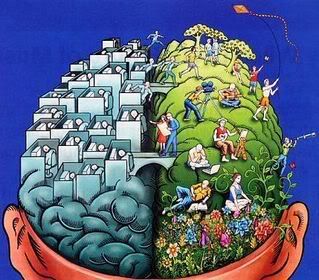
The days of the pure left brain thinkers (planners) and pure right brain thinkers (creative’s) could be numbered. The new breeds of advertisers will infuse creativity with strategy.
They will bring strategic direction and art direction.
They will bring insight and creative flair.
Above all, they will design profitable yet appealing solutions.
One of the things that were said to me by a traditional planner is: your course is too far ahead of advertising. Basically, it is already producing “creative strategists” like me. I found it very difficult to put a label on what I do; I'm a strong creative but just as strong analytically. So I don't fit into any set agency role without losing one aspect of my skills. The larger, more traditional agencies don’t have room for us yet. They will have in 5 years when the changes have happened but until then we have to choose what we want to lose, creativity or strategy.
The type of role a creative planner would play was summed up nicely on Ivans blog over at adsoftheworld.com:
This guy brings to the table his knowledge and proficiency in understanding a client. Strategic thinking is definitely a pivotal part of this new role, but at the same time he can creatively interpret data coming from the client, and create a platform for the creative team. He gets a task from the client for which he creates an insightful brief. Then he briefs the creative team, giving them enough meat to create a campaign. The team then gets back to him with the solution, which he evaluates, keeping in mind the client's requirements and also the creative aspect. If satisfied, he presents the work to the client.
So what are your thoughts? Is this already happening? Does it need to start to happen?
At 3 Monkeys No Banana we are often approached by small start-ups wanting marketing/branding advice and direction, which of course if fine. However what we seem to find is that we are undertaking a lot more than simply brand strategy, it turns into business strategy. A lot of businesses come to us with business problems and try to answer these through branding. Of course you can't solve an underlying business problem through brand strategy.
The most common problem for this seems to be the lack of understanding of the customer’s needs, they have a product or service yet know little in terms of how this is any different then an existing offering or how their particular product/service can fulfil a customers need, whether that be functional or emotional. It can be frustrating at times especially when the owner of the business doesn't see a need to carry out research or feels he/she knows enough through assumptions.
Every business should start by identifying its markets, primary and secondary. Finding out how their product benefits them, what their customers want, need, fear, live and breathe. I can’t see how you can start a business venture without having a deep understanding of who your customers are!
As marketers the first hurdle for us is convincing the client that simply creating a nice logo, print ad and slogan won't sell the product. One of the things we try to do is help them understand their value proposition and then devise and deliver a more defined and measurable strategy along with understanding their market, customers and innovative marketing techniques.
The worst thing, well most frustrating is when they have worked with "marketing" people before who are nothing more than bedroom graphic designers. The clients have the ideology that producing a few pieces of marketing literature that simply communicate the product and its features will gain sales and brand loyalty. Strategy defines your communications not creative. It takes a lot sometimes to drive this message home to business owners.